A trophy provides a lasting reminder of sporting achievement. Long after the final whistle, winning run, or decisive point, the award remains a physical record of victory. Some trophies pass between generations of champions, while others become permanent possessions of the athletes or teams that earned them.
Sports trophies range from medals awarded at local events to elaborate championship cups recognized worldwide. Their designs often reflect the origins, traditions, and identity of the competitions they represent.
The history of sporting awards also reveals how organized competition has changed. Materials and manufacturing techniques have evolved, while professional leagues and international tournaments have introduced new presentation traditions. Throughout these developments, trophies have retained their central purpose: recognizing achievement and preserving its significance.
What Is a Trophy in Sports?
A sports trophy is a physical award presented to an athlete or team for competitive success, exceptional performance, or a contribution to a particular sport. Trophies include championship cups, shields, figurines, plaques, and other commemorative objects.
Not all sports awards recognize tournament champions. Organizers also honor individual performances, statistical achievements, fair play, and distinguished careers. Golden Boot awards in football, for example, recognize top goalscorers in individual competitions rather than championship-winning teams.
An important distinction exists between permanent and perpetual trophies. Permanent awards become the recipient’s property. Perpetual trophies remain under the ownership of the organizing body, although winners may hold the original for a limited period. Some competitions provide replicas that champions can keep.
The significance of an award rarely depends on its size or material value alone. A modest cup can become an important historical object through its association with celebrated athletes, memorable performances, or longstanding competitions.
The History of Sports Trophies
Early Athletic Awards and Symbols of Victory
Trophy history extends far beyond the development of modern championship cups. In ancient Greece, sporting victories carried religious and civic significance. Olympic champions received olive wreaths, while winners at the Pythian Games in Delphi were traditionally awarded laurel wreaths.
These prizes were valued for what they represented rather than their materials. Victory at a major festival brought public recognition and could elevate an athlete’s standing throughout the Greek world.
Successful competitors sometimes received additional honors from their home cities, including financial rewards, privileges, and commemorative statues. Sporting achievement could enhance the reputation of an entire community.
European sporting traditions later introduced decorative silverware, ceremonial cups, and engraved objects. Aristocratic patrons, sporting clubs, and organized societies presented such awards at competitions and public ceremonies.
During the nineteenth century, the expansion of organized sport encouraged the use of recurring championship trophies. Rather than commissioning a new award for every event, organizers could present the same cup to successive winners, establishing a visible connection between different generations of competitors.
How Modern Championship Trophies Developed
As national associations and professional leagues expanded, trophies became official symbols of organized championships. Their presentation was increasingly governed by competition rules rather than the preferences of individual patrons.
First contested in the 1871–72 season, the FA Cup became one of the earliest enduring examples of a football competition associated with a dedicated championship trophy.
Ice hockey developed another distinctive tradition. In 1892, Lord Stanley of Preston donated a silver bowl intended to recognize Canada’s leading amateur hockey team. The award eventually evolved into the Stanley Cup, now presented to the National Hockey League champion.
During the twentieth century, newspaper photography, television broadcasts, and international sporting coverage made championship awards familiar to audiences far beyond the stadium.
Distinctive shapes became particularly important. A trophy could be recognized from its outline alone, especially when raised during a championship celebration.
Modern designers continue to balance tradition with practical requirements. Durability, engraving space, transport, security, and reproduction all influence how an award is constructed.
Different Types of Sports Trophies
Cups and Championship Shields
Among the different types of trophies, the championship cup remains one of the most familiar. Traditional examples feature a bowl, sometimes fitted with handles, supported by a stem or base. Their designs developed from ceremonial vessels and decorative metalwork.
Some retain classical proportions, while others combine traditional elements with contemporary sculpture. Larger cups may consist of several separately manufactured components assembled into a single structure.
Championship shields serve a similar purpose, although their flat surfaces distinguish them from conventional cups. The format has historical connections with heraldic decoration and ceremonial presentations.
England’s FA Community Shield provides a prominent football example. Its broad surface accommodates decorative elements and inscriptions without the deep bowl associated with traditional cup trophies.
Both formats are well suited to trophies passed between successive champions. Additional bases, plates, or supporting structures allow organizers to record championship winners over time.
Medals, Plaques and Figurines
Medals provide an efficient way to recognize numerous competitors at the same event. They are relatively easy to manufacture consistently, transport, and personalize.
In many competitions, gold, silver, and bronze medals distinguish first, second, and third place, respectively. These terms describe competitive rankings and do not necessarily indicate the medals’ complete material composition.
Plaques offer space for names, dates, competition emblems, and commemorative inscriptions. They are commonly used for club presentations, individual honors, and recognition of contributions to sport.
Figurine trophies often depict athletes in action. Representations of runners, footballers, gymnasts, or other competitors make the award’s sporting connection immediately recognizable.
Contemporary manufacturing also supports less conventional designs. Glass, acrylic, resin, and cast-metal trophies can reproduce tournament emblems, sporting equipment, or abstract shapes.
The award format generally reflects the occasion. A large championship cup may suit an established professional competition, while medals are practical for events involving hundreds of individual participants.
Famous Trophies in Sports History
The FIFA World Cup Trophy
The FIFA World Cup Trophy is one of international sport’s most recognizable awards.
Its current design was introduced in 1974, replacing the Jules Rimet Trophy. Brazil had received the earlier award permanently after winning its third men’s World Cup in 1970.
Italian sculptor Silvio Gazzaniga designed the replacement. Two human figures rise from the base and support a globe above their heads. Unlike a traditional championship cup, the sculpture expresses triumph through the human form.
The trophy stands approximately 36.8 centimeters tall, weighs 6.175 kilograms, and is made from 18-carat gold. Green malachite bands decorate its base.
Ownership rules also distinguish the modern award from its predecessor. FIFA retains ownership of the original trophy. Winning national teams receive the official FIFA World Cup Winners’ Trophy, a gold-plated replica that they can keep permanently. The original remains under FIFA’s control rather than passing into the ownership of successive champions.
Its distinctive silhouette has become inseparable from the tournament’s visual identity.
The Stanley Cup
The Stanley Cup stands apart from many championship awards because its physical structure has changed over time.
Lord Stanley’s original silver bowl was relatively modest. As the competition developed, additional sections were introduced to accommodate records of championship-winning teams.
The practice of engraving winners’ names evolved gradually during the twentieth century. Today, eligible players, coaches, and other team personnel can have their names recorded on the trophy. Eligibility is governed by NHL rules, with exceptions requiring league approval.
The Cup’s cylindrical structure includes removable bands containing inscriptions from previous championship seasons. When space runs out, older bands are removed and preserved, allowing new names to be added without continually increasing the trophy’s height.
Its traditions extend beyond the presentation ceremony. Members of the championship-winning team are typically given opportunities to spend personal time with the Cup, taking it to meaningful locations or sharing celebrations with family and communities.
Few major sporting awards display such an extensive physical record of the people and teams associated with their history.
The Wimbledon Trophies
The Wimbledon Championships maintain two contrasting traditions for their singles awards.
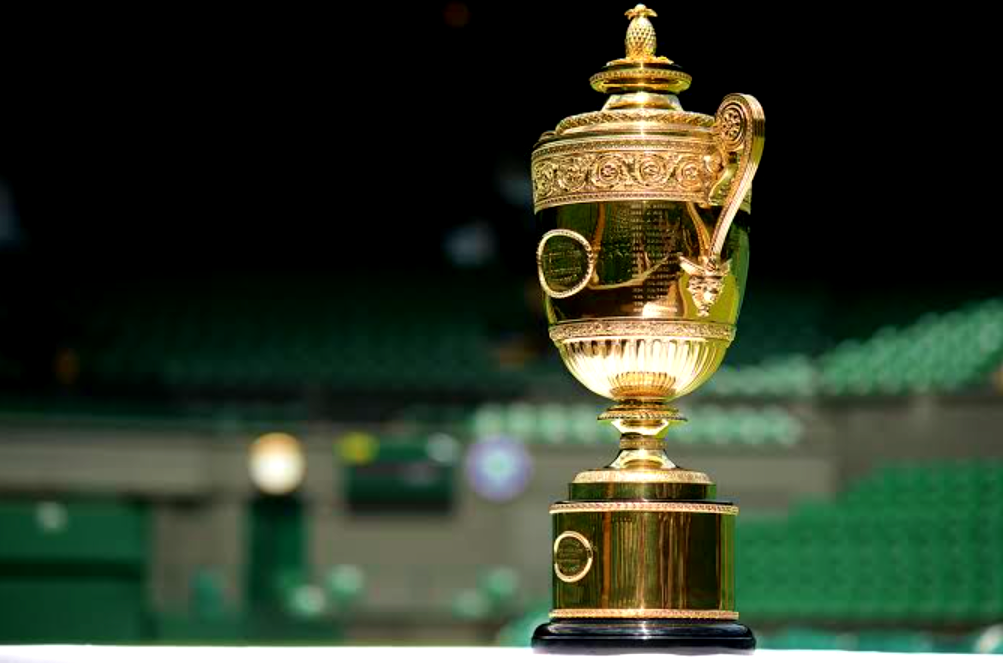
The Gentlemen’s Singles Trophy is a silver-gilt cup introduced in 1887. It replaced earlier challenge cups that William Renshaw had won outright through successive championship victories.
The Ladies’ Singles Trophy, commonly known as the Venus Rosewater Dish, is a decorated silver salver first presented in 1886. Its elaborate imagery draws on classical mythology and Renaissance decorative traditions.
Both historic trophies remain in the possession of the All England Club. Singles champions receive smaller replicas rather than permanent ownership of the original awards.
Their contrasting appearances demonstrate how different objects can acquire comparable prestige through craftsmanship, historical continuity, and association with a major sporting event.
Materials Used to Make Sports Trophies
Manufacturers select trophy materials according to appearance, durability, weight, production costs, and intended use. Many awards combine several substances rather than relying on a single metal or decorative material.
Silver and silver-plated alloys have a longstanding association with championship cups. Their reflective surfaces support detailed decorative work, although exposed silver requires protection against tarnishing. A silver trophy may therefore contain solid silver, silver-plated metal, or a combination of materials.
Gold-colored trophies vary considerably in composition. A gold trophy may contain solid gold or gold alloys, while more affordable examples use gold plating or decorative finishes over base metals. The FIFA World Cup Trophy is an exceptional example of an award manufactured from high-value gold alloy.
Bronze, brass, and zinc alloys are frequently used for cast trophies. They can accommodate intricate shapes and different surface treatments, depending on the manufacturing process.
Other common materials include:
- Crystal and glass: used for transparent awards, polished surfaces, and decorative optical effects.
- Acrylic: lightweight and suitable for precisely cut shapes, lettering, and contemporary designs.
- Wood: commonly incorporated into bases, plaques, and traditional presentation pieces.
- Resin: suitable for molded figurines and complex shapes at comparatively accessible production costs.
- Stone: marble, granite, and decorative minerals provide substantial bases and distinctive finishes.
Construction must account for the properties of each component. Heavy metal sections need secure supports, while glass elements, delicate handles, and ornamental attachments require protection against damage.
Trophy Engraving and Personalization
Trophy engraving connects a manufactured award to the achievement it commemorates. Names, dates, competition titles, and other identifying details establish a record that may remain attached to the object for decades.
Traditional hand engraving allows skilled craftspeople to produce inscriptions and decorative patterns directly on metal. Mechanical engraving offers consistent lettering, particularly when multiple awards require identical formatting.
Laser engraving and marking systems can create precise lettering and designs on compatible metals, coated surfaces, wood, and acrylic. The resulting finish depends on the equipment, material, and process. Some methods alter surface color rather than cutting deeply into the object.
Common inscriptions identify the winning athlete or team, the competition, the year, and the award category. Perpetual trophies may include chronological records of previous champions.
Careful proofreading is essential before production. Incorrect names, dates, or competition titles can permanently compromise an otherwise well-made award. Organizers should confirm spelling, formatting, and the final layout before engraving begins.
How Trophy Design Reflects Sporting Traditions
A trophy’s appearance can communicate the identity of a competition before anyone reads its inscription.
Traditional cups frequently evoke institutional history and continuity. Sculptural awards may emphasize athletic movement, physical strength, or equipment associated with a particular discipline. Shields can reference club heritage, while geometric forms offer greater flexibility for newer sporting events.
Shape and proportions also influence how an award is perceived. A tall, narrow trophy can appear imposing, while a broad silver plate conveys a different sense of ceremony. Compact awards often prioritize portability and straightforward presentation.
The design must also accommodate practical handling. Winners need to lift and carry the trophy safely, while organizers must transport it between venues without damaging its structure. Large or irregularly shaped awards may require specially fitted cases and reinforced supports.
Distinctive silhouettes often prove more memorable than elaborate decoration. Recognition from a distance is particularly valuable during televised presentations, when viewers may see an award only briefly.
Vintage Sports Trophies and Collecting Memorabilia
Vintage trophies attract collectors because they preserve tangible connections to sporting history. Some commemorate important championships, while others carry the names of athletes, clubs, and institutions that have disappeared.
The market for collectible sports trophies includes original competition awards, presentation pieces, and historically significant objects associated with individual athletes. Provenance can strongly influence their value, alongside rarity, condition, craftsmanship, and historical significance. An ordinary school championship cup may have little resale value but considerable importance to a local sporting community.
Original competition awards also differ from commercially produced sports memorabilia. A trophy presented to an athlete has a particular ownership history, whereas an officially licensed miniature or commemorative reproduction serves a different collecting purpose.
Authenticating an older award requires attention to inscriptions, maker’s marks, period photographs, competition records, and ownership documents. Decorative style alone is insufficient to establish an object’s origin.
Previous restoration work can complicate authentication. Replacement bases, altered inscriptions, and refinished surfaces may conceal evidence of the original construction.
For historically important trophies, preserving and documenting original features is generally preferable to extensive cosmetic restoration.
How Sports Trophies Are Preserved and Restored
Proper trophy preservation involves controlling environmental conditions, limiting unnecessary handling, and selecting cleaning methods suited to the materials.
Metals, coatings, wood, adhesives, and decorative stones respond differently to moisture, temperature changes, and chemical exposure. A cleaning product suitable for one component may damage another.
Silver can tarnish through reactions with sulfur-containing compounds in the surrounding environment. Repeated aggressive polishing gradually removes surface material and may weaken fine engraved details. Abrasive cleaners and solvents can also damage lacquered finishes.
Stable storage conditions help limit deterioration. Display cases reduce dust accumulation and handling, while suitable supports protect fragile stems, handles, and ornamental attachments from unnecessary pressure.
Routine maintenance generally consists of gentle dust removal and inspection for corrosion, loose components, damaged coatings, or structural weaknesses.
Historic awards require particular care. Professional conservators can assess the materials, stabilize deterioration, and recommend repairs that preserve the object’s original character.
Restoration should not automatically eliminate signs of age. Original finishes, inscriptions, and manufacturing marks may provide important evidence of a trophy’s history. Museums and sporting institutions often document conservation treatments so later custodians can identify repairs and replacement components.
FAQ
What is the difference between a trophy and a medal?
A trophy is a broad category of sporting award that includes cups, shields, figurines, and other commemorative objects. A medal is a specific type of award, usually a small metal disc worn on a ribbon or presented in a case. Medals are particularly suitable for competitions with numerous individual recipients.
Are championship trophies made of real gold?
Some championship trophies contain genuine gold, but many feature gold plating or gold-colored finishes over less expensive materials. Even prestigious awards may combine precious metals with other components. Appearance alone does not establish an award’s composition.
Why do some sports trophies stay with the organizers?
Perpetual trophies preserve a continuous connection between successive champions. Institutional ownership also helps protect historically significant awards. Depending on competition rules, winners may temporarily hold the original or receive a permanent replica.
What makes a sports trophy valuable to collectors?
Historical significance, documented ownership, rarity, condition, and craftsmanship influence collectible value. Awards associated with notable athletes or major competitions may attract particular interest. Reliable provenance is especially important when establishing authenticity.
Can an old sports trophy be restored?
Many trophies can be cleaned, stabilized, or repaired, depending on their construction and condition. However, aggressive polishing or replacing original components may reduce historical value. Significant or fragile awards should be assessed by a qualified conservator before restoration.