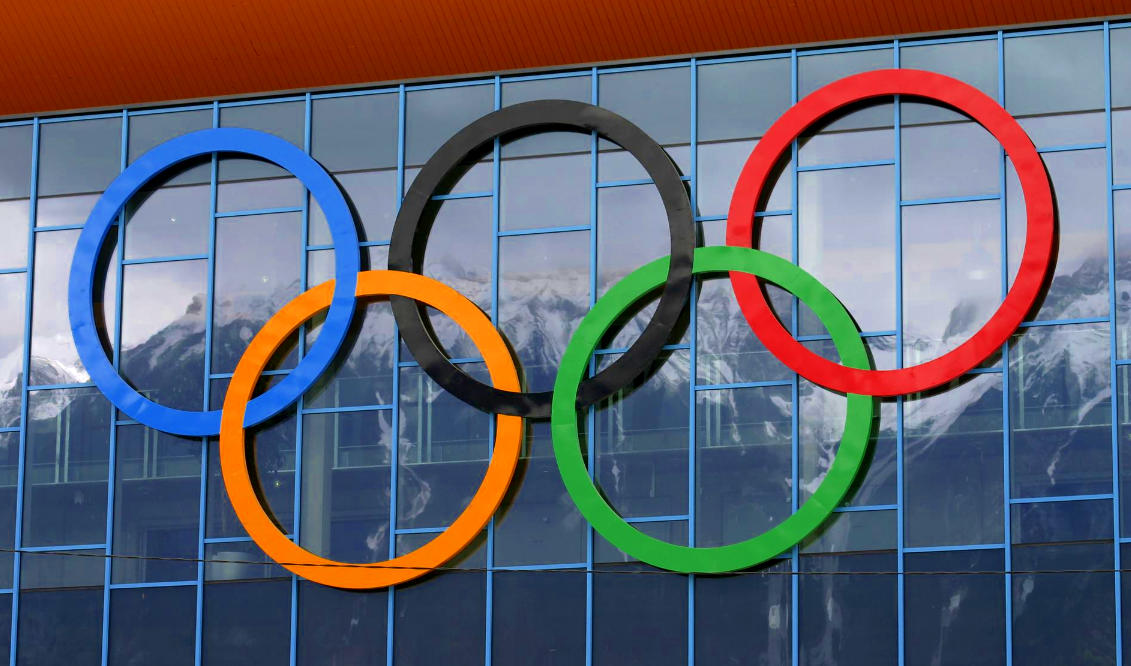
Five interlocking circles have become one of the most recognizable images in international sports. They appear on Olympic flags, inside stadiums, during television broadcasts, and throughout host cities. The design is simple, but its history reaches back to the early years of the modern Olympic Games. French educator Pierre de Coubertin created the Olympic rings in 1913 to reflect the Games’ expanding international reach.
The emblem represents the union of five continental regions and the gathering of athletes from around the world. Its colors, arrangement, and history also carry meanings that are frequently misunderstood. The meaning of the Olympic rings is rooted in the ambitions of the early Olympic Movement. Their first appearance at the Games was delayed by World War I, and their use today is governed by international protections and official design standards.
What Do the Olympic Rings Represent?
The five Olympic rings represent the union of Africa, the Americas, Asia, Europe, and Oceania within the Olympic Movement. This division follows a historical sporting convention rather than a universal geographical classification. North and South America are treated as one continental region, while Antarctica is excluded. The interlocking design expresses the international character of the Games. Athletes from different countries compete under shared rules while representing their own national sporting traditions. The rings provide a common emblem for that competition.
Their meaning does not depend on the number of sports included in the Olympic program or the structure of individual events. The five circles also have no connection to the five disciplines of the ancient pentathlon. Although circles can suggest continuity or unity in visual design, the International Olympic Committee (IOC) identifies the union of the five continents and the worldwide gathering of athletes as the symbol’s central meaning.
Who Designed the Olympic Rings?
Pierre de Coubertin, a French educator, historian, and sports administrator, designed the Olympic rings in 1913. Coubertin played a leading role in reviving the Olympic Games. His efforts helped establish the IOC in 1894, and the first modern Olympics took place in Athens two years later.
By the time of the 1912 Stockholm Games, the modern Olympics had attracted participants from across the continental regions represented in Coubertin’s vision. The competition was developing an international identity that needed a recognizable symbol. His solution was a composition of five connected circles, each in a different color. The emblem was not borrowed from ancient Greece.
The ancient Olympic festivals inspired the revival of the Games, but there is no historical evidence that their organizers used the familiar five-ring design. Coubertin may have drawn inspiration from the interlocking rings associated with the Union des Sociétés Françaises de Sports Athlétiques, a French sporting organization in which he held a leading position. The five-ring Olympic emblem, however, was his own creation.
Pierre de Coubertin and the Olympic Movement
Coubertin regarded physical education as an important part of intellectual and personal development. He believed international sporting competition could encourage discipline, mutual understanding, and contact between people from different societies. He became the IOC’s second president in 1896 and held the position until 1925. During his presidency, the Olympics developed from a newly revived competition into a more established international event.
His ideas also reflected the social attitudes of his era. Coubertin opposed women’s participation in certain Olympic competitions, a position that conflicts with the principles of gender equality promoted by the modern Olympic Movement. Later changes to Olympic participation, particularly the expansion of women’s events, moved the Games beyond Coubertin’s original vision. The rings remained a symbol of an international sporting ideal that continued to evolve.
When the Symbol First Appeared
The earliest known drawing of the Olympic rings dates to 1913. Coubertin sketched the five colored circles at the top of a letter, creating the design that would become the Olympic emblem. The symbol was publicly presented during the Olympic Congress in Paris in 1914, held to mark the twentieth anniversary of the IOC’s founding. Plans to introduce the new Olympic flag at the Games were interrupted by World War I. The 1916 Summer Olympics, originally scheduled for Berlin, were canceled. Antwerp hosted the next Summer Games in 1920, when the Olympic flag bearing the five rings appeared at the Olympics for the first time. These dates mark three distinct stages in the history of the Olympic rings: the original design in 1913, its public presentation in 1914, and its Olympic debut in 1920.
The Meaning of the Five Olympic Rings
The rings form a single composition, with five circles of equal size arranged in two overlapping rows. The design places three rings above two others, creating a balanced arrangement without assigning greater symbolic importance to any individual circle. The overlapping circles create a compact design that remains recognizable at different sizes. Each ring retains its own outline, while the interlocking arrangement visually connects all five. This symbolism extends across the Olympic program. Athletics, swimming, gymnastics, cycling, and other sports have their own rules, governing bodies, and competitive traditions. The Olympic rings identify their participation within the same international event. Individual nations retain their flags and identities. Host cities develop separate emblems for each edition. The five rings, by contrast, remain a permanent visual identifier of the Olympic Movement, regardless of where the Games take place or which sports appear on the program.
Why Are the Olympic Rings Different Colors?
The five Olympic rings colors are blue, yellow, black, green, and red. Together with the white background of the Olympic flag, they form the six-color design described by Coubertin. His explanation concerned national flags, not a separate color assigned to each continent. When introducing the emblem in 1913, Coubertin explained that the six colors, taken together, reproduced the colors of the national flags of the world at that time. He illustrated the idea with examples from several countries, including France, Britain, Germany, Belgium, Italy, Sweden, Greece, Brazil, Australia, Japan, and China. The selection reflected the international ambitions of the early Olympic Movement. It was not intended to establish a color-coded map of the continents. This distinction matters because the continent-color interpretation remains common in educational materials, illustrations, and general sports trivia.
The Six Colors of the Olympic Flag
The complete Olympic flag includes five colored rings on a white field. The arrangement follows a standardized pattern:
- Blue: the left ring in the upper row.
- Black: the center ring in the upper row.
- Red: the right ring in the upper row.
- Yellow: the left ring in the lower row.
- Green: the right ring in the lower row.
- White: the background of the Olympic flag.
The rings interlock in a fixed arrangement, with three circles above and two below. Their relative positions are part of the official design and must be preserved in authorized reproductions. The white background is integral to the flag’s historical six-color explanation. It also provides contrast, allowing the individual rings to remain clearly visible. The official design is governed by IOC specifications covering proportions, positioning, colors, and approved forms of reproduction.
Common Misconceptions About the Ring Colors
One widespread interpretation assigns blue to Europe, yellow to Asia, black to Africa, green to Oceania, and red to the Americas. The IOC does not recognize these individual color assignments. The five rings collectively represent the continental regions, while their colors reflect Coubertin’s original explanation concerning national flags. Another misconception links the rings to five major Olympic sports.
The Olympic program has never been defined by a permanent group of five disciplines, and no such connection appears in the documented history of the emblem. The symbol is also occasionally presented as an ancient Greek design. Its documented origin in 1913 rules out that interpretation.
How the Olympic Rings Became a Global Symbol
Recognition of the rings grew as the Olympics reached larger international audiences. When Coubertin introduced the design, the modern Games were still relatively young. Their audiences were growing, but international broadcasting had not yet transformed the Olympics into a global media event. The 1920 Antwerp Games brought the emblem onto the Olympic stage. Over subsequent decades, the rings appeared on flags, official publications, competition materials, and ceremonial displays.
Radio broadcasts expanded public interest in the Games, although the rings themselves gained greater visual exposure through newspapers, photography, newsreels, and eventually television. Television was particularly important. Viewers could recognize the Olympic emblem without attending an event or visiting a host city. As international coverage expanded, the same five circles appeared before audiences across different countries and generations.
Unlike host-city emblems, which change with each edition, the Olympic rings provide continuity. Their appearance connects competitions held decades apart, from the early twentieth century to the present. The symbol also appears in materials produced by the IOC, national Olympic committees, organizing committees, and authorized Olympic partners. Its recognition extends well beyond competitive sport. The rings are associated with Olympic ceremonies, cultural programs, educational initiatives, and the wider public identity of the Games.
The Olympic Rings in Ceremonies and Sporting Traditions
Olympic ceremonies place the rings among the most prominent images of each edition. During the opening ceremony, the Olympic flag is brought into the stadium and raised. It traditionally remains displayed throughout the Games. The closing ceremony includes the lowering of the flag. Ceremonial handover traditions also connect the current host with the organizers of the next edition. Host cities frequently incorporate the rings into stadium installations, public spaces, and temporary displays. Their appearance can vary considerably, from large illuminated structures to sculptural arrangements integrated into the local setting.
The emblem is also visually associated with other Olympic traditions, although these have separate histories. The Olympic flame and cauldron are central ceremonial features. The Olympic oath expresses commitments associated with participation and fair competition. The motto, Citius, Altius, Fortius – Communiter (Faster, Higher, Stronger – Together), expresses the Movement’s athletic aspirations and emphasis on solidarity. Among Olympic Games symbols, the rings serve as the principal visual identifier of the Olympic Movement itself.
Olympic Rings in Medals, Pins and Collectible Memorabilia
The Olympic rings appear on numerous objects connected with the Games, including medals, badges, commemorative coins, clothing, posters, and collector’s pins. Not every object displaying the emblem is an official sporting award. Competition medals, commemorative medals, and commercial souvenirs serve different purposes. Olympic competition medals are created for individual editions and must comply with IOC requirements.
Host organizers have opportunities to incorporate artistic details reflecting the identity of their Games, although certain design elements are prescribed. Commemorative medals are different. They may celebrate a host city, an anniversary, a sporting achievement, or another Olympic-related occasion without being awarded as part of a competition.
Olympic Pins and Collecting Traditions
Pin trading has become a familiar part of Olympic culture. Athletes, volunteers, journalists, officials, spectators, and collectors exchange badges during the Games. Some pins display the five Olympic rings alone. Others incorporate national flags, mascots, sporting equipment, or host-city emblems.
Officially licensed Olympic memorabilia may also include stamps, coins, apparel, and limited-edition collectibles. Collectors often distinguish between commercially available souvenirs and objects distributed specifically to athletes, officials, or accredited participants. An item’s origin, condition, documented history, and production quantity can all influence its significance. Authenticity matters particularly with older Olympic objects.
A reproduction may resemble an original closely, while an item with reliable provenance can offer stronger evidence of its historical connection to a particular edition. The consistent use of the rings helps identify Olympic-related objects, but the emblem alone does not establish that an item is genuine or officially licensed.
Rules for Using the Olympic Rings Symbol
The Olympic rings are protected intellectual property. Their international recognition does not make them available for unrestricted commercial use. The IOC holds rights associated with the Olympic symbol, while national Olympic committees and other authorized organizations may exercise specific rights under applicable arrangements. The Olympic Charter establishes the principal framework for protecting Olympic properties. National trademark laws and international agreements provide additional safeguards.
One important international instrument is the Nairobi Treaty on the Protection of the Olympic Symbol, adopted in 1981. Countries bound by the treaty must provide protections against certain unauthorized commercial uses of the Olympic symbol, subject to the treaty’s provisions. These protections concern the recognizable five-ring emblem, not simply a particular digital image or illustration.
Official Design and Reproduction Requirements
The Olympic rings design follows standardized specifications. Authorized users must preserve the emblem’s visual integrity and comply with the rules applicable to the version being reproduced. Typical requirements address:
- The established order and arrangement of the five rings.
- Correct proportions, spacing, and alignment.
- Approved color and monochrome versions.
- Restrictions on distortion, rotation, or alteration.
- Appropriate backgrounds and surrounding visual elements.
The IOC’s branding requirements determine how the symbol may appear in authorized materials. Commercial use on merchandise, packaging, advertising, or promotional products generally requires permission. An independently redrawn version of the five rings is not automatically exempt from intellectual property protection. Editorial and informational uses may be treated differently under applicable laws. News organizations and publishers can sometimes reproduce
Olympic imagery when reporting on the Games, but such use must not misleadingly suggest official sponsorship or endorsement. The scope of permitted use depends on the relevant jurisdiction, the context of publication, and the manner in which the symbol is displayed. Organizations planning commercial applications should consult the relevant IOC guidance, national Olympic committee requirements, and applicable intellectual property laws.
FAQ
What do the five Olympic rings symbolize?
The five interlocking rings represent the union of Africa, the Americas, Asia, Europe, and Oceania within the Olympic Movement. Their arrangement reflects the international character of the Games and the gathering of athletes from around the world.
Who created the Olympic rings?
Pierre de Coubertin, the French educator who helped revive the modern Olympic Games, designed the rings in 1913. He also served as president of the International Olympic Committee from 1896 to 1925.
When were the Olympic rings first used?
The design dates to 1913 and was publicly presented in 1914. The Olympic flag featuring the rings first appeared at the Games in Antwerp in 1920, following the cancellation of the 1916 Olympics during World War I.
Why are there five Olympic rings instead of six or seven?
The number reflects the five continental regions traditionally represented in Olympic symbolism. The Americas are treated as one region, while Antarctica is not included. This follows the Olympic Movement’s historical convention rather than every modern geographical classification.
Does each Olympic ring color represent a continent?
No. The IOC does not assign a particular continent to each color. Coubertin selected blue, yellow, black, green, and red, together with the white background, to reflect colors appearing in national flags during the early development of the modern Olympic Movement.
Can anyone use the Olympic rings logo?
Not for every purpose. The rings are legally protected, and commercial use generally requires authorization. Certain editorial or informational uses may be permitted under applicable laws, provided they do not falsely imply official Olympic affiliation or sponsorship.